
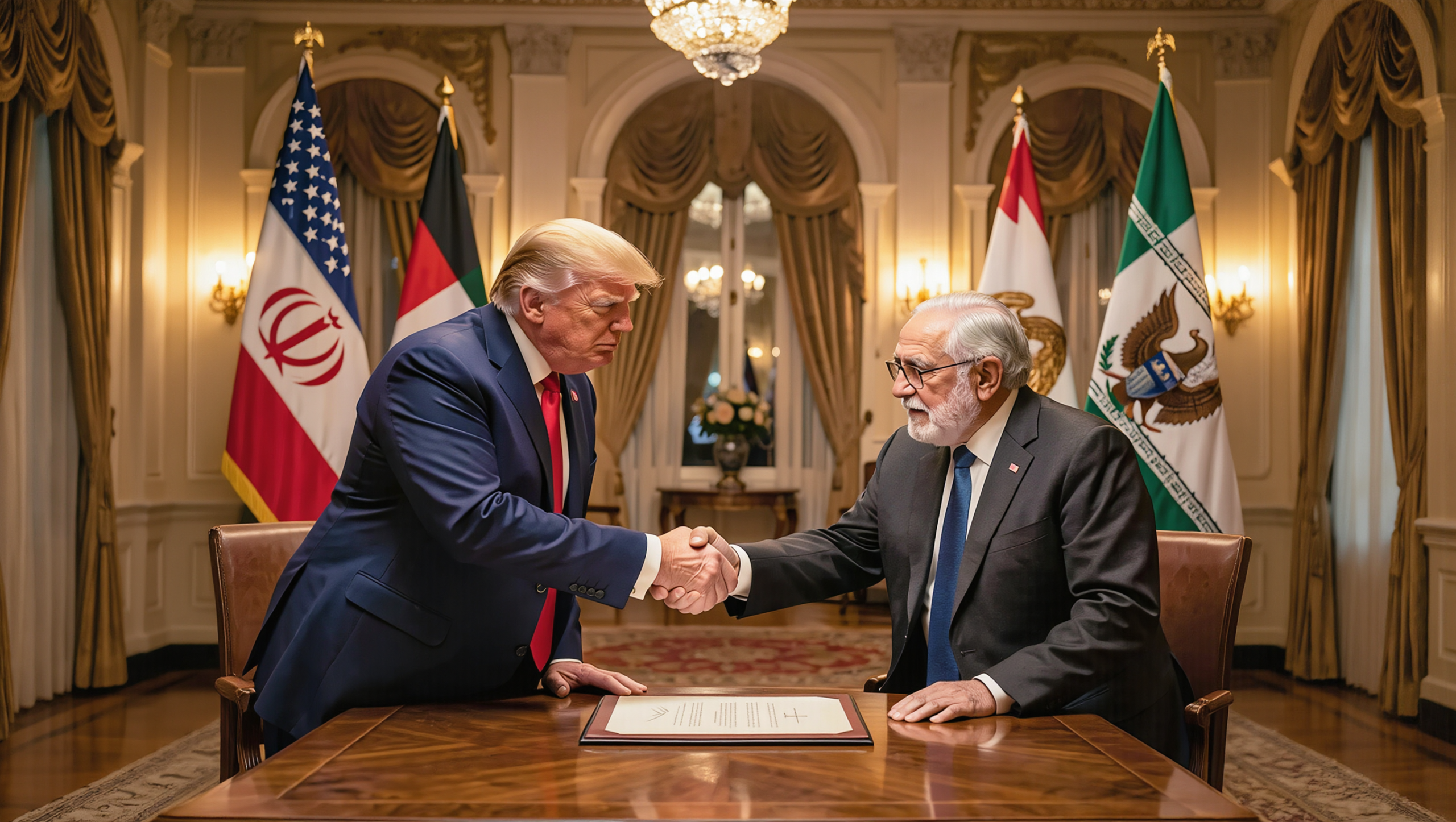
Every broker in Dubai is sending the same message right now: the war is over, the peace deal is signed, list your property — the market is bouncing back exactly like it did after COVID. Some are calling the whole conflict a “missile crisis,” implying a scary headline with no lasting consequences. The transaction data tells a different story, and it starts with the document everyone is celebrating.
THE DEAL ITSELF
The US-Iran memorandum of understanding was signed over the weekend and published June 17th — a memorandum, not a final peace deal.
Fourteen points define it: a ceasefire across all fronts including Lebanon, a final deal to be negotiated within 60 days, the US lifting its naval blockade, and Iran keeping the Strait of Hormuz open free of charge for 60 days.
From there the terms tilt sharply toward the US conceding ground. A 300 billion dollar reconstruction fund for Iran. Oil export waivers. Frozen assets unfrozen. Brett McGurk, who negotiated with Iran under three US administrations, pointed out the structural imbalance directly: Iran’s actual obligation expires in 60 days, while everything afterward is American concessions — and the nuclear question that caused the war in the first place has been deferred entirely to a “final peace deal” that doesn’t exist yet.
Three days after signing, Trump publicly expressed dissatisfaction with the agreement he had just signed. Iran is calling the MOU a US loss and has confirmed plans to charge a Hormuz transit fee once the 60-day window closes. And Israel — the country that started this war — isn’t even party to the talks in Switzerland. Inside Israel, the deal is being described as Netanyahu’s personal defeat on what had been his “life project,” while the country’s defense minister has confirmed troops will remain in Lebanon, Syria, and Gaza indefinitely.
Three signatories, none of them fully satisfied with what they signed. That is the foundation underneath every “the market will bounce back” phone call happening across Dubai this week.
THE MARKET WAS ALREADY AT A PEAK, NOT A BOTTOM
The COVID comparison brokers keep making rests on a flawed premise. Before COVID, Dubai prices had been falling since 2014 — 2020 hit the bottom of a multi-year correction, so anything after that had nowhere to go but up. This conflict hit the opposite point in the cycle. Analysts were already warning of a 15 percent correction in 2026 before a single missile was fired. The war didn’t create this vulnerability — it accelerated a correction that was already loading.
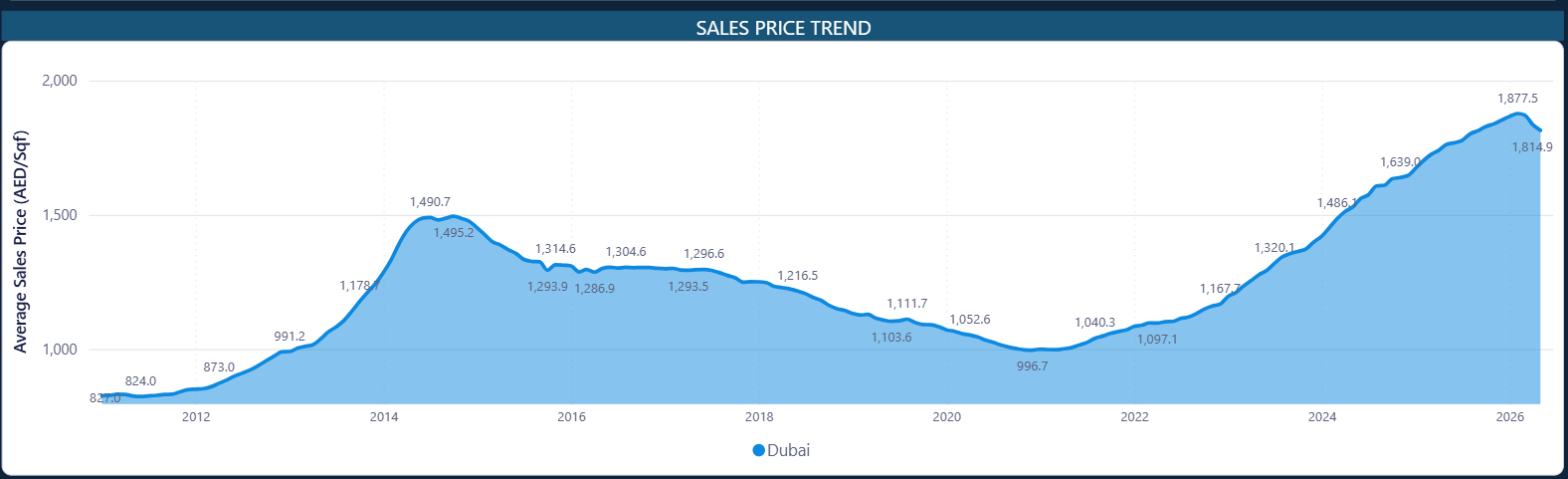
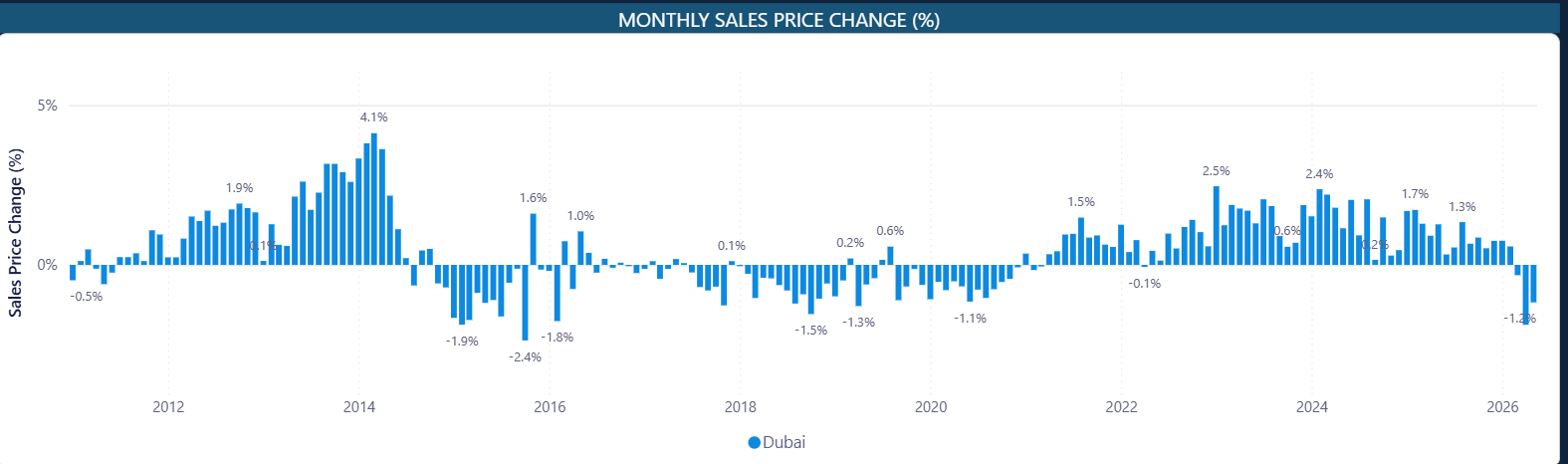
The data confirms it. Dubai’s monthly sales price change climbed almost continuously from 2021 through 2025, with peaks of 2.5, 2.4, and 1.7 percent across that run. The most recent reading: minus 1.2 percent — the first negative month in five years. Off-plan transaction volume tells the same story from a different angle, collapsing from 270 deals a month at peak to just 31, an 88 percent drop.
RENT IS ALREADY ROLLING OVER
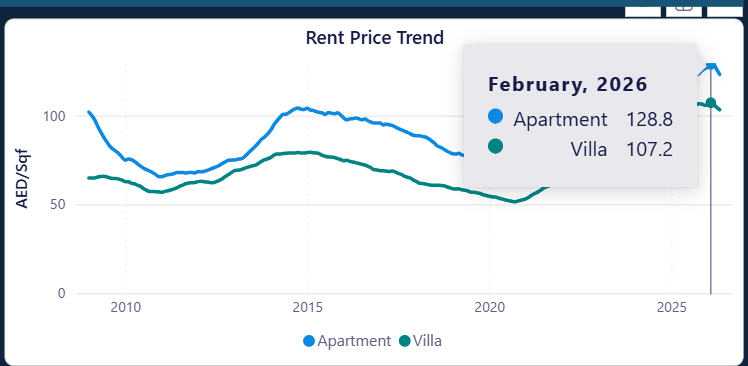
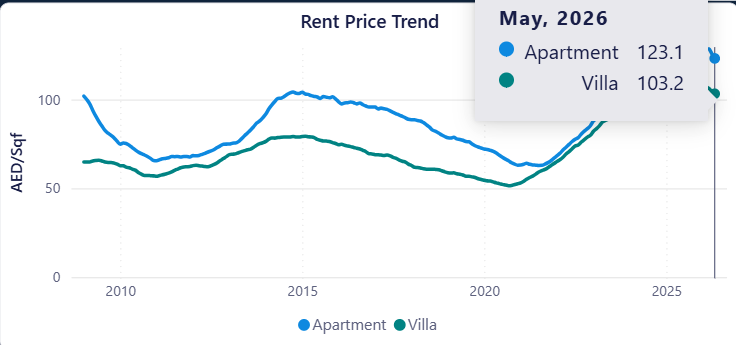
Sale prices move slowly. Rent moves first. Current rent peaked at 128.8 AED per square foot — 24 percent above the previous all-time high set in 2014 — and the very next reading already dropped to 123.1. Asking rents confirm it from the listing side: down 16.5 percent in six months. Villas have been hit hardest, with yields falling from roughly 6 to 4.5 percent and the payback period stretching from 17 years to nearly 23.
There’s a number behind this that brokers rarely mention. New rental contracts only dropped 1.4 percent this quarter — looks stable on the surface. Renewal contracts dropped 17 percent. The gap exists because landlords are quietly slashing renewal rates to avoid empty units, while public asking prices lag far behind what’s actually closing in private negotiations.
THE SPECULATIVE LAYER HAS LEFT THE MARKET
Off-plan volume collapsed 88 percent, yet price per square foot barely moved — still near AED 3,900. That divergence between vanishing volume and sticky pricing is a classic late-cycle signature, not stability. Total transaction value confirms the scale: off-plan deals fell from 870 million AED a month at peak to 220 million, while supply keeps expanding regardless — 526,000 units under construction against 639,000 existing, an 82 percent increase to total stock.
Abu Dhabi’s much-cited record sales figures don’t contradict this. Abu Dhabi’s monthly sales momentum hit an all-time high of 4.1 percent, immediately followed by a negative reading of minus 0.4 percent — the first negative print after the strongest run in its dataset’s history. Its rental momentum reversal was sharper still: a 3.4 percent record followed by minus 1.9 percent the very next month. Abu Dhabi rode the same wave Dubai did and is now turning over just as hard, cushioned only by a smaller supply pipeline and higher existing occupancy — not because the underlying cycle is different.
In both cities, asking prices for sale are still climbing or holding flat while actual transaction prices have already peaked and turned down. That gap isn’t a contradiction — it’s a tell. Sellers haven’t yet accepted that the peak is behind them.
WHY THIS ISN’T A QUICK BOUNCE EITHER WAY
If the ceasefire breaks down — and with three unhappy signatories, that’s a real scenario — even the short-term bounce brokers are promising won’t materialize. But the deeper issue is structural: property doesn’t reprice in real time. A demand shock shows up with a lag and clears with an even longer one, because selling a property takes months, not milliseconds. The MOU creates a 60-day window. Real estate transactions do not move on a 60-day clock.
WHAT THIS MEANS
This isn’t a forecast of collapse. It’s an argument that “it’s just a missile crisis, the market will bounce back” skips past everything the data is already showing: a correction that was overdue before the war started and just posted its first negative monthly reading in five years, a rental market rolling over from a record high, a speculative off-plan layer that has already exited while sellers haven’t priced in the exit, and even Abu Dhabi quietly posting its sharpest reversal in over a decade.
The market of opportunities is ahead, not behind. Smart capital buys from the people who bought when prices were high — not the other way around.
The full breakdown, including the actual MOU document and the Israel angle nobody’s broker is mentioning, is in the video below.
If this shift plays out the way the data suggests, the opportunities will show up first in the distress layer — sellers who bought at peak optimism and now need to exit as the gap between cost basis and current market becomes real. That is the inventory tracked on this site.


Join The Discussion