THE “GUARANTEED BUYBACK” THAT ISN’T
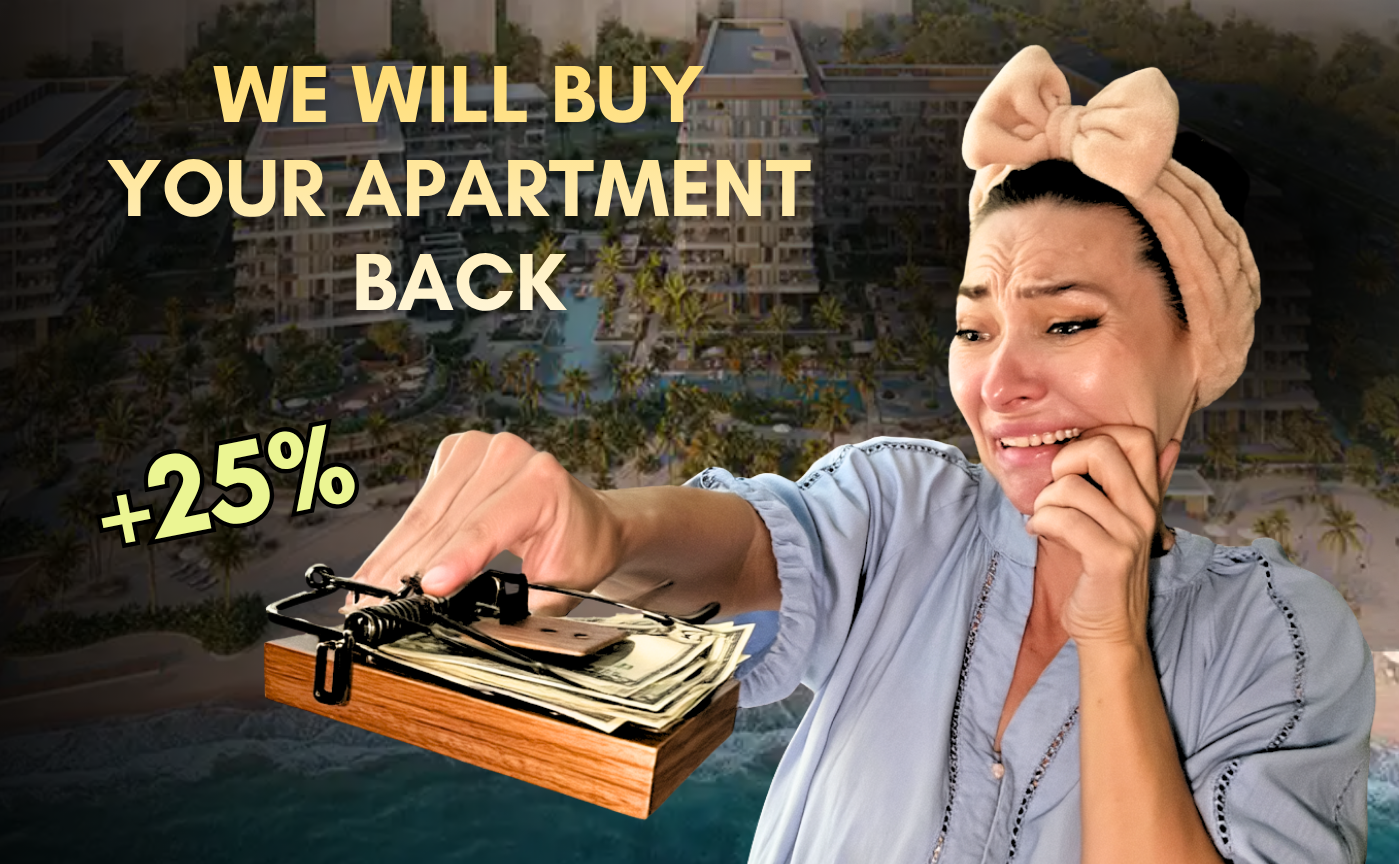
A developer offers to buy your apartment back in two years, at 25% above what you paid. Cash, upfront, no lender involved. In a market that’s cooling, ask yourself: who hands out returns like that for free? Nobody. Either it’s free money, or you’re funding someone else’s cash-flow problem — and calling it an investment.
Here’s the mechanism, and why it survives.
TWO CONTRACTS, ONE STORY
You sign a standard-looking SPA — escrow, Oqood, the 4% transfer fee, all present and correct. Alongside it, a second, much shorter agreement: the buyback guarantee. That’s the one that matters, and it’s built differently.
In practice: your payment skips escrow and lands in the developer’s own account. The sale is never filed with the Land Department. Legally, you never became the owner — the unit stays exactly where it was. The Oqood registration and the escrow account aren’t formalities; they’re the only things actually protecting your money. Neither happens here.
The buyback contract itself is worded as a “Sale and Purchase” — never “loan,” “interest,” “lender.” That’s not sloppy drafting, it’s the whole design: dressed as a property sale, it needs no lending license and sits outside the Central Bank’s and the securities regulator’s reach. Nothing in UAE law explicitly bans a company from borrowing cash from individuals this way — but that’s a gap nobody’s tested in court yet, not a green light.
WHAT’S ACTUALLY IN THE FINE PRINT
From a real contract I reviewed (names stripped — this is about the mechanism, not one company):
You sign a clause claiming the property is already registered in your name with no outstanding debts — even though it isn’t. The buyback clock only starts once the developer issues a Completion Notice, on their own timeline, which they can also push back a year, penalty-free. You then get 30 days to confirm you want the buyback — miss that window for any reason, and the agreement auto-terminates. Buried in the force majeure clause, next to war and natural disasters: “financial distress.” If the developer runs out of money, they’re contractually excused from buying you out — the exact moment the guarantee would matter. The terms are confidential, so you can’t compare notes with other buyers. And when the buyback payment does happen, there’s no escrow — just a same-day bank transfer, on trust, with a company that already told you in writing it can walk away.
The math
Say the unit’s worth 800k on the open market. You pay 1M — 200k over value, day one. In 2.5 years, the developer buys it back for 1.25M. Looks like a 25% return. Strip out your own 200k overpayment coming back to you, and the real profit is 50k — about 2% a year. Meanwhile the developer got 1M in cash today at a real cost cheaper than a bank loan (Dubai mortgage rates run 3.7–4.5%), and in the worst case — “financial distress” — pays nothing at all. Scale that to 40 units and you’re looking at 40M+ raised with no bank, no escrow, and every incentive to pay early investors with the next batch’s money.
There was a legitimate way to raise this cash without a bank: a joint venture, where the landowner contributes land as equity and shares the upside. Transparent, and the risk sits with people who chose to take it — not with buyers who didn’t know they had any.
It’s already been tested — elsewhere
Dubai hasn’t seen this challenged in court, publicly, yet. India has. In September 2025, after a six-year fight, India’s Supreme Court ruled on near-identical structures — post-dated cheques that bounced, promised 25%-in-two-years buybacks — and classified those investors as speculators, not homebuyers, using a checklist that reads uncomfortably close to what’s above: a buyback option instead of taking possession, unusual terms outside the standard buyer contract, and “unrealistic” short-term returns of 20–25%. The Court’s own phrase: these are “financial derivatives masquerading as housing contracts.” The investors were eventually owed their money — but lost the priority protection ordinary homebuyers get, and had to restart their claim in regular court from zero.
Bottom line
Not every guaranteed buyback is a scam. But a guarantee that lives outside escrow and outside the property register isn’t a guarantee — it’s a hope, with better marketing. Read the full contract before you sign it, not after.



Join The Discussion